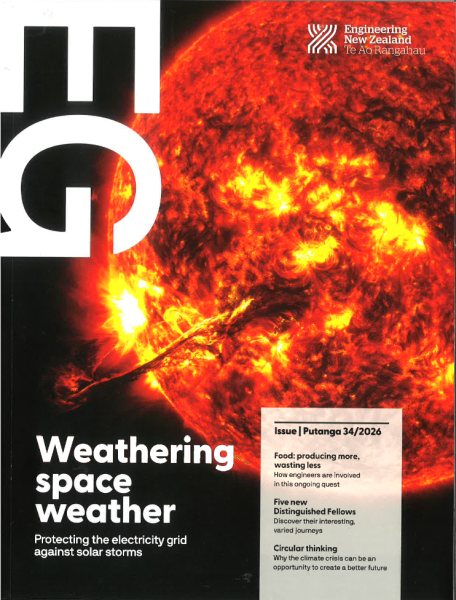
An in-depth article about the hazard posed by extreme space weather to the NZ electrical grid, and the work being done by the Solar Tsunamis project along with Transpower and NEMA, is a feature article in Issue 34 of Engineering New Zealand magazine. The article is also available to read on their website. Here is an excerpt:
How engineers and other experts are helping to protect New Zealand’s electricity grid against solar storms.
New Zealanders are familiar with natural hazards: earthquakes, volcanoes, landslips, floods, hydrothermal activity, tsunami – many of us have had our daily lives impacted by at least one of these. But there is a natural hazard missing from that list. One that doesn’t pose the same immediate risk to our safety, but which has dire implications for our electricity infrastructure, putting it front-of-mind for a growing number of organisations across Aotearoa: space weather. This is a catch-all term to describe a range of phenomena originating from the Sun, which, despite being ~150 million km away, influences every aspect of life on Earth. We’re most familiar with the Sun’s photons – the light it generates – which drive everything from the process of photosynthesis to our planet’s weather and water cycles. But light is not the only thing that reaches us from the Sun.
Our Sun screams… and belches
As a massive, dynamic ball of super-hot plasma, the Sun also creates twisted magnetic fields whose complex interactions lead to more dramatic solar activity.
“You can think of both solar flares and coronal mass ejections (CMEs) as huge explosions on the Sun,” says Professor Craig Rodger from the University of Otago. While these two events can occur simultaneously, they differ from one another, and they each have different impacts on Earth.
Flares are bright bursts of radiation (everything from gamma rays to microwaves) that travel in all directions at the speed of light. US-based space weather scientist Dr Tamitha Skov describes flares as “solar screams” which might be loud, but don’t physically hurt anything. The strongest flares do nothing more than disrupt radio communications that pass through the upper atmosphere, leading to temporary radio blackouts.
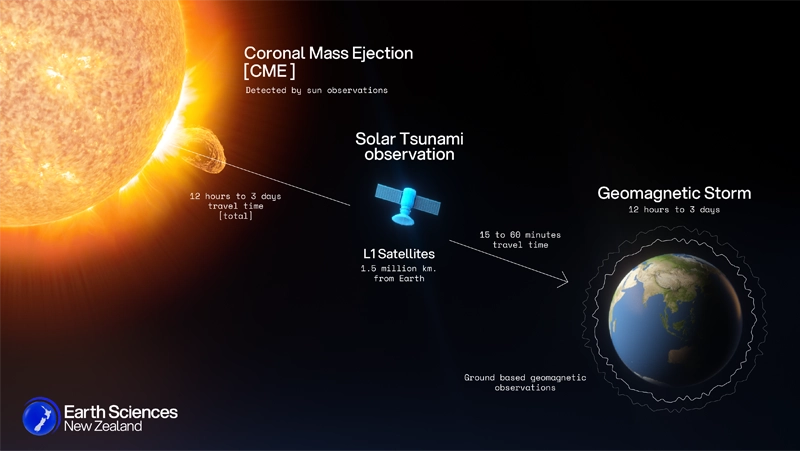
In contrast, CMEs are giant clouds of the Sun’s plasma – and its magnetic fields – that are expelled from the Sun, akin, Tamitha says, to “… a belching out of tonnes of material” – not just photons but particles too. That difference has a huge impact on speed. Light travels at approximately 300,000 km per second through the vacuum of space, which means it takes about eight minutes for sunlight to reach us. In contrast, the slowest CME moves at around 300 km per second, so its journey to Earth can take up to five days. Once a CME gets here, its magnetic fields interact with the Earth’s, which can trigger geomagnetic storms.
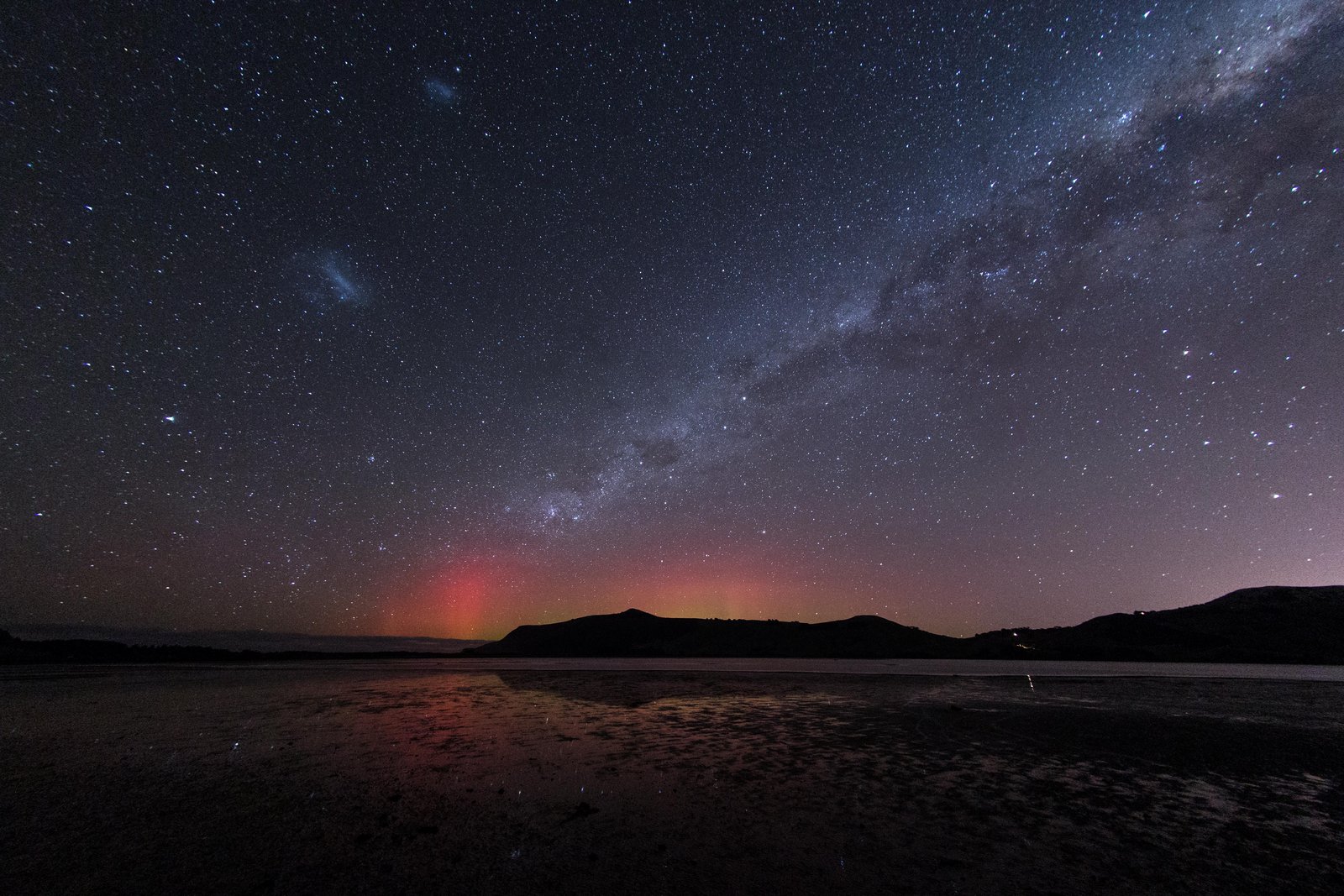
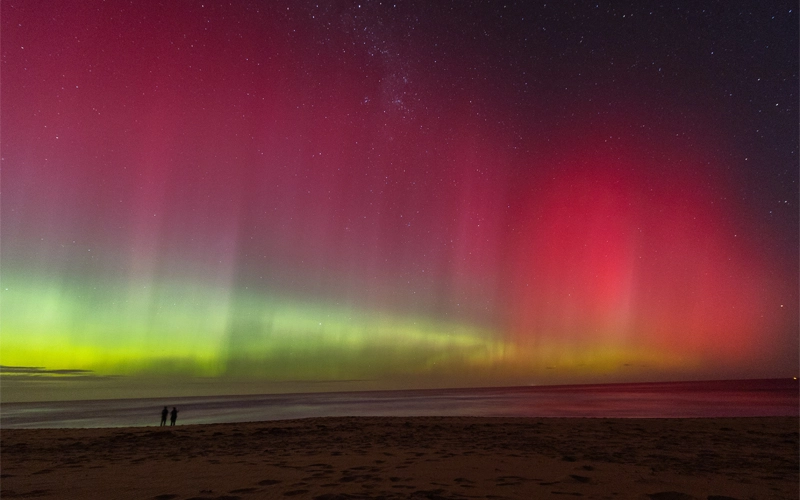
“For most of human history, the only sign of a geomagnetic storm occurring was the aurora dancing across the sky,” says Craig. But today, for those managing electricity grids, strong CMEs can spell disaster. A CME’s arrival can induce powerful electrical currents, known as geomagnetically induced currents (GICs), and voltage instabilities in long transmission lines. In extreme conditions, these unwanted GICs can even overload transformers, causing them to fail, leading to widespread power outages.
For most of human history, the only sign of a geomagnetic storm occurring was the aurora dancing across the sky.
Where science meets industry
Thankfully, none of this is news to Matt Copland MEngNZ, Transpower’s Head of Grid and System Operations, who says, “We’ve been thinking about and making preparations for extreme solar storms for years.”
Part of this preparedness comes through accessing data and alerts from satellites that are dedicated to monitoring solar activity. These tend to sit at the L-1 point – a location in space between the Earth and Sun where their gravitational forces balance out.
“L-1 is about 1.5 million kilometres away,” says Craig. “So, for normal CMEs, we get about an hour’s warning that it’s coming. For the really fast ones, we might only get 15 or 20 minutes.”
“That’s not enough time for us to actually implement a response,” says Matt. Instead, Transpower must act on forecasts of previous storms, “… assume it’s going to be the big one, and get the grid into the best state of readiness we can before the CME hits that L-1 satellite”.
Once the CME approaches Earth, ground-based measurements become important. Magnetic observatories, including at Eyrewell in north-west Christchurch and at Scott Base in Antarctica, can measure changes in the Earth’s magnetic field. And there is a network of sensors across the electricity grid that monitor GICs and temperature spikes.