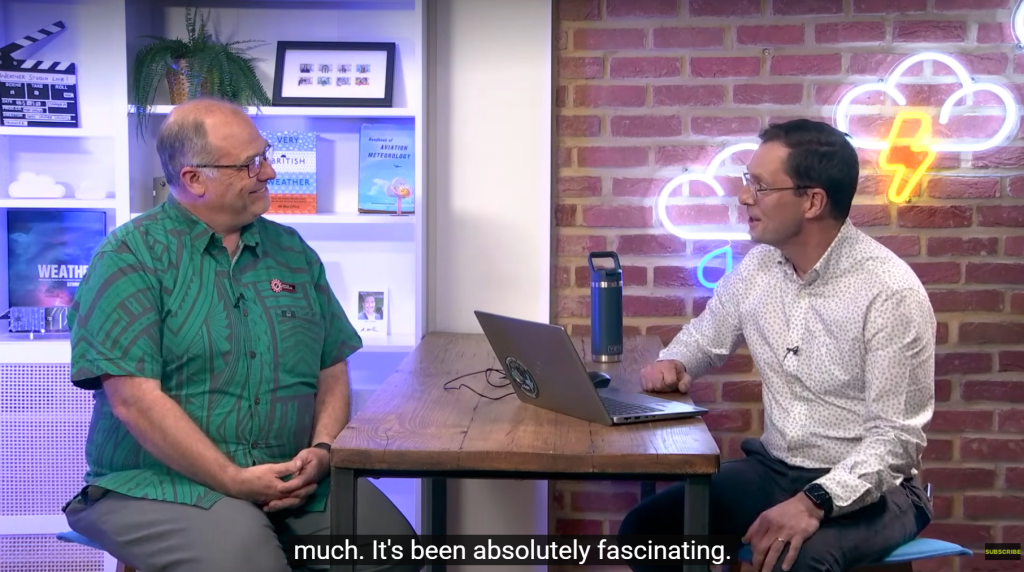
Alex Deakin in conversation with Professor Craig Rodger, University of Otago.
Read on below for a lightly edited transcript and images from the video.
Contents
Click the links below to read the transcript for each section:
- Introduction: What is Space Weather? (0:00)
- Solar Tsunamis: Coronal Mass Ejections and the Magnetosphere (08:56)
- The aurora: What are we actually seeing? (17:05)
- The real risks: Satellites, GPS, and the power grid (23:37)
- The Gannon Storm of May 2024 and protecting the grid: New Zealand’s mitigation plan (34:05)
- The historic Carrington Event and how we measure storms (37:55)
- Forecasting space weather: The L1 point and warning times (44:30)
- Preparing for the worst: From “the bunker” to international collaboration (51:42)
1. Introduction: What is Space Weather?
Timestamp: 0:00
Narrator: You’re listening to the Met Office Deeper Dive, in-depth conversations with the world’s leading weather and climate experts.
Alex Deakin (AD): Hello everybody, and welcome along to this new format for the Met Office, A Deeper Dive. My name’s Alex Deakin, and we are delving deep into the world of space weather today.
So, we’re having an in-depth conversation with an expert, and very welcome along, to you, Professor Craig Rodger from New Zealand, from the Department of Physics, University of Otago. Thank you for being here.
Craig Rodger (CJR): Thank you for having me.
AD: Do you want to give us a bit of an overview of what you do, what your job is and why you’re here in the UK?
CJR: Okay, so I am a, I’m a professor of physics, a Beverly professor of physics. I’m a physics nerd. So, I teach physics at a university. I mostly teach first year classes because … because it’s fun.
AD: Right, okay.
CJR: And, but my research area is space physics and that it has evolved in the last 10 years into space weather, which is where space physics becomes useful. So, where it’s applied to our human technology.
AD: Okay.
CJR: And that is why I’m here visiting Exeter and the Met Office, because you have MOSWOC. You have one of the world leading prediction centres operating 24/7.
So, I’m here to talk to those fine people.
AD: Fantastic we made a video about the space weather we do here at the Met Office and it’s good that you’re at … you’re Involved, you’re working with those guys over here, but how does it… How does it work in New Zealand, space weather-wise? Do you have a … is there a meteorological department, do they have a space weather area or is it separate?
CJR: The Met Service in New Zealand, so you have the Met Office, we have the Met Service. They do not have as part of their roles space weather. They have been interested in trying to get into that area. They had a plan to collaborate with the Met office in MOSWOC to develop capability, but they could not get it funded.
And so, at this point, we in New Zealand are relying on advice from international partners.
AD: Okay, okay, and you play a part of that as from the Department of Physics at the University in Dunedin. What, what, I mean, let’s start with the basics. What would you define space weather as? What is space weather?
CJR: Okay, so space weather is a technical term used to describe how changes in the environment in the space around the Earth, all the way down to the surface of the Earth can negatively couple to our human technology. And negatively couple is code for make it not work, all way to break it permanently. And the thing is, Space Weather is caused by the Sun, activity on the Sun particularly explosions on the Sun. Now, they’ve been happening for billions of years. But we didn’t notice until we got around to getting clever enough to develop technology that was … suddenly started becoming sensitive to space weather. So, you have to go back to sort of the development of the telegraph in the 1800s before human beings noticed.
Now, of course, the exception would be Aurora. One of the cool things about space weather is that it drives Aurora in the night sky. Humans and pre-humans would have seen that in the night sky and probably worshipped it. But… Now, we have developed all this complex technology, which is such a fundamental part of our lives and our economy, and yet it’s made us sensitive to the Sun, which is why we have to take it seriously.
AD: Very seriously, yes. So, we talk about space weather but it’s actually really weather from the Sun, it’s only really from the Sun we’re talking about, and it’s the way that the Sun sends stuff to Earth.
CJR: Yes, really it’s the Sun sending stuff to Earth and that interacting with our environment. So that might be interacting with the magnetic field of the Earth, it might be interacting with the atmosphere and the charged part of the atmosphere of the Earth and then that coupling to our technology.
AD: But why does the Sun, we know about sunspots, we’ve known about them for a long time, why do we get sunspots, why is there this cycle, what’s going on in the Sun to create this, it’s an 11-year cycle.
CJR: Yeah, so well to some extent that’s an active research question – exactly why we have an 11-year cycle. But It’s very strongly linked to the fact that the Sun is a big ball of plasma, right? It’s a big burning ball of plasma like it’s hugely massive. It’s huge. And it’s threaded with a magnetic field. Oh, very hot.
It’s got a really, really strong magnetic field, and one of the things that’s important to recognise, there’s a difference between a planet like the Earth and the Sun. The Earth is a solid ball, obviously so you can imagine it’s like a soccer ball. And so when you spin it, it all spins together and that will drag the magnetic field all around at the same rate.
The Sun is a big ball of burning gas, right? So, if you spin, it because it’s gas, it doesn’t all have to spin at the same rate. And so, the top and the bottom of the Sun, the poles, are spinning at different speeds than the middle. And so, if you start off with a nice magnetic field like we learned about at school… That gets distorted by the differential rotation, the fact that it’s rotating at different speeds.
And so, you can sort of imagine the idea of these magnetic field lines getting wrapped and twisted and convoluted. That’s just storing energy. And eventually the Sun has to release a large amount of energy that’s stored, which it tends to do explosively. So the Sun goes, BANG!
AD: And that’s a sunspot?
CJR: Oh, no, no. That’s a solar flare. A sunspot, weirdly, is these convoluted magnetic field lines poking out of the surface of the Sun, which causes a dark spot on the solar surface. And because it’s dark – it’s not really dark, it’s darker than the surrounding Sun, we see it as a sunspot. And when there’s lots of them, you know, it looks like the Sun’s got lots of acne. And when there’s not lots of them, the solar disc is clear.
And that’s the solar cycle. So, you go from this over 11 years, you go from a period with almost no sunspots, which we call solar minimum, all the way up to lots of sunspot, solar maximum, and then down.
And when solar maximum is occurring, and that’s because the magnetic field of the Sun is very, very distorted and kinked and convoluted, you’ve got lots of explosions. You’ve got lot of activity. You’ve got space weather.
AD: And that’s where we’re at at the moment, right, we’re at the peak …
CJR: We’re just a little bit past solar maximum at the moment, these are the exciting times. These are the times when we are relying on the forecasters who are watching the Sun all the time to be looking out for the interesting times.
AD: Right so we’ve got interesting times, we’ve got a lot going on, but every kind of … why do we even have a magnetic field? Why does the Earth and the Sun have a magnetic field?
CJR: For the Earth, it’s because we’ve got a big spinning lump of metal, and we’ve got molten rock that is conducting, that is flowing, and so you’ve got a spinning magnetic field. It’s like a big engine, a big electrical engine.
The Sun, it is not rock, it’s hot gas. Because the Sun is so massive, the gravity is so high, it’s compressed very, very hard. And then you’ve got these moving gases that are setting up a magnetic field.
AD: That sets up the magnetic field. It’s always there, but it gets twisted and convoluted and gets more excited.
CJR: And it’s incredibly strong, if you, yeah, no, it’s incredibly strong.
AD: Right. Okay. Okay, so we’re not entirely sure what causes that 11-year cycle then?
CJR: My understanding is that people have theories, but it’s not at the point that we’re absolutely sure. But one thing that is cool, you can look at the Sun and you can see for example that the x-ray output from the Sun varies with an 11-year Cycle. So you can that our Sun has an 11-year cycle. If we look at other stars in for example x-rays, you can see that they have a cycle too. It’s not 11 years. It varies from star to star to star. But you know, we’ve known that our Sun isn’t that special for a long time and it turns out that those other stars will also have space weather. Just a bit different, right, but they are definitely experiencing those solar cycles – they will have magnetic fields they will get twisted and convoluted.
2. Solar Tsunamis: Coronal Mass Ejections and the Magnetosphere
Timestamp: 08:56
AD: So, they get twisted, they get convoluted, and then the Sun spits something out.
CJR: Explodes.
AD: Explodes, okay, in bits. And I mean, a lot of the time that doesn’t hit Earth, right? It doesn’t do anything. So, it’s happening quite a lot, but it doesn’t affect us that often because we’re quite small compared to the Sun and it misses us, right.
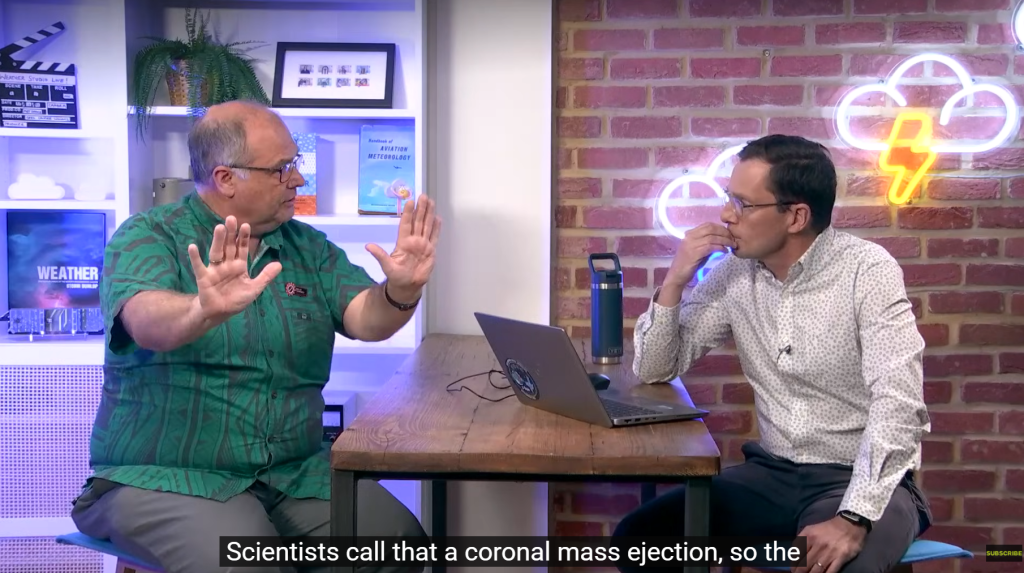
CJR: And so, what we’re often particularly interested in is if that tangle, which explodes, occurs a little bit inside the solar atmosphere, and then it throws out a chunk of material. Scientists call that a coronal mass ejection, so the ejection of mass from the solar corona. It’s a very descriptive name.
In New Zealand, we have been sort of convincing people to call those events solar tsunamis. And that’s mostly because in New Zealand, the general public knows what a tsunami is. It’s triggered by an earthquake. That then sends a wave of material possibly to New Zealand, but possibly not, depending if it’s going in a different direction. And it takes time for it to get to us.
If you have a coronal mass ejection, it’s triggered by an explosion on the Sun, it takes time to get it to us, it may or may not be pointing at us. We can call them coronal massive ejections, that’s the science name, but if we link that idea to tsunamis that the public already knows about, it just helps clarify the threat and people say-
AD: That’s really interesting the way that you use that because, like you say, because in New Zealand we’re used to tsunamis, it’s that understanding, so it’s interesting from a communication point of view.
CJR: Absolutely, and we have a lot of geo hazards in New Zealand. We have earthquakes, we have volcanoes, we have tsunamis. It’s only relatively recently that people have started thinking about space weather in New Zealand. We’re behind the UK in terms of that, but one of the advantages is that we have so many… Geohazards and people have plans for what to do if this hazard comes along and that hazard comes along, so some of the government departments and major businesses can go look at their business continuity plans and say oh, that bit is relevant for space weather, this bit is relevant for space weather that has helped us get going a bit faster.
AD: Right okay so let’s get back to the stuff, the coronal mass ejection, the tsunami’s happened it’s on its way, what is it made of what is actually coming out of the Sun?
CJR: So, um, a physicist would call it plasma. So it’s a gas of hot electrons and protons carrying the magnetic field of the Sun out with it at high speed. Now a typical CME will take about two days to go from the Sun to the Earth. That’s 150 million kilometres. So, we think of that as a fast transition time because it’s going 150 million kilometres in two days.
Relative to the speed of light, as you know, it’s 8 minutes from the Sun to the Earth at the speed of light. But it’s still… Quite fast.
AD: It’s quite fast, it’s quite hot, it is quite energetic. There’s a lot going on there. So, it’s a mixture. It is plasma, protons, electrons spewed out. Can we put size on that. How big are these things? How many times the size of Wales?
CJR: I find it useful … Oh, well, let’s not use Wales as a measuring technique.
AD: We do in the UK quite a bit. We just compare things to the size
CJR: It’s, it’s, vastly, vastly bigger than Wales. It’s vastly bigger than Earth. So, if you think of, if you have the Sun, and it fires off a solar tsunami, the size of it, in terms of the disc, so if you go around the Sun like this, how big will the solar tsunami be when it gets out to the Earth? It’s about a fifth. Of the circle. Right, so it’s BIG.
Now, okay, a fifth means that it could be, it could miss us, it could have a glancing blow, where there’ll be an effect, or it could be directed straight at us.
AD: Right. And that would be bad.
CJR: It happens. It would be interesting
AD: It would be interesting, okay. So we’ve got this plasma spewed out how long do you say it takes generally?
CJR: Typically, about two days. Some are slow, they might be more like three, three and a half days. Generally, the faster they are, the more interesting they are. And I believe the fastest we’ve seen is on the order of about 16 hours.
So … it’s a lot faster than two days. And so that’s one of the things that people have to work really hard at when they see that explosion coming off the Sun, they see the coronal mass ejection coming off the Sun. It’s trying to make an estimate of how fast it’s coming. Is it pointing at us? That’s obviously very, very important. But then, how soon until it arrives?
AD: And that’s what the scientists are doing here at the Met Office.
CJR: That is what the people at MOSWOC, the forecasters at MOSWOC are doing… Up there now
AD: Literally 50 metres away from us. So that’s what’s going on … Spewed out, comes along, going through space, not doing … nothing to interact with, potentially then hits the Earth, but hits the Earth’s magnetic field … exactly it doesn’t hit straight into it
CJR: No, it hits the magnetosphere of the Earth, the region of space around the Earth which is dominated by the Earth’s magnetic field.
AD: Can you put a size on that, where I bring in Wales again.
CJR: The size of the magnetic field. Oh yes, so if you go from the surface of the Earth out towards the Sun, you go about 10 Earth radii. Before you get to the front of the magnetosphere. If you go away from the Sun …
AD: Because it’s got a tail, doesn’t it?
CJR: Because it’s blown out like a tail. Yeah, yeah, yeah. It’s like a rock and a stream. It looks like a comet. It’s more than 100 Earth radii, so it’s spread out in that direction. And I think of a solar tsunami or coronal mass ejection as being a bit like, I grew up in the era of comics, right? The cartoons on TV. And so it was like Green Lantern’s hand. This huge hand comes out of the Sun and it crashes into the magnetosphere of the Earth and it squeezes it, right? And that compresses the magnetosphere of the Earth. And that’s what triggers all the interesting processes.
AD: So, what happens, so why do we have, what use is the magnetosphere?
CJR: Okay, it’s not a thing we built, right, so it’s useful. It’s there, it is part of the natural environment, but it does protect us from, for example, hot particles coming from space. It’s a filter, it’ s partly a protective shield.
Some of the other planets, Mars is a good example, Mars used to have a magnetosphere but a few billion years ago, Mars cooled and the magnetosphere went away. The atmosphere of Mars is much, much thinner because this flow of particles from the Sun has been flicking the top of the Martian atmosphere out into space.
AD: Taking bits with it.
CJR: Taking a bit with it, it’s taken a couple of billion years, but the atmosphere of Mars now is about 1% of the thickness of the atmosphere on Earth, so it’s rubbish, you know, you wouldn’t want to be on Mars. Elon Musk, maybe he wants to go to Mars, right? He can colonise Mars. The atmosphere on Mars is going to be an unfun place to be because it’s not going to breathable. Here, nice place.
AD: Someone should tell him. Okay, so why, go back to, so Mars, why did the, so they’ve got an iron, is there an iron core in Mars? Why did it go away? I’m not sure why.
CJR: The plate tectonics died … It got cold so there wasn’t enough heat trapped inside the planet for the processes inside to keep going. So Mars used to have volcanoes, you may have heard of Olympus Mons the biggest mountain in the solar system, apparently it’s so big it pokes above the atmosphere of Mars. It’s amazingly big, right? It’s an old volcano, but Mars is dead. Okay. Sad. However, that’s the magnetic field of Mars. Earth. We have this atmosphere, we’re protected, but when a coronal mass injection comes in, it squeezes that atmosphere down. And triggers things like the aurora.
3. The aurora: What are we actually seeing?
Timestamp: 17:05
AD: Right. So that’s where we get the aurora from.
CJR: Yes. So the energy coming in…
AD: So the plasma hits the magnetic field and it lights up the sky. So what’s going on with the aurora? What are we seeing?
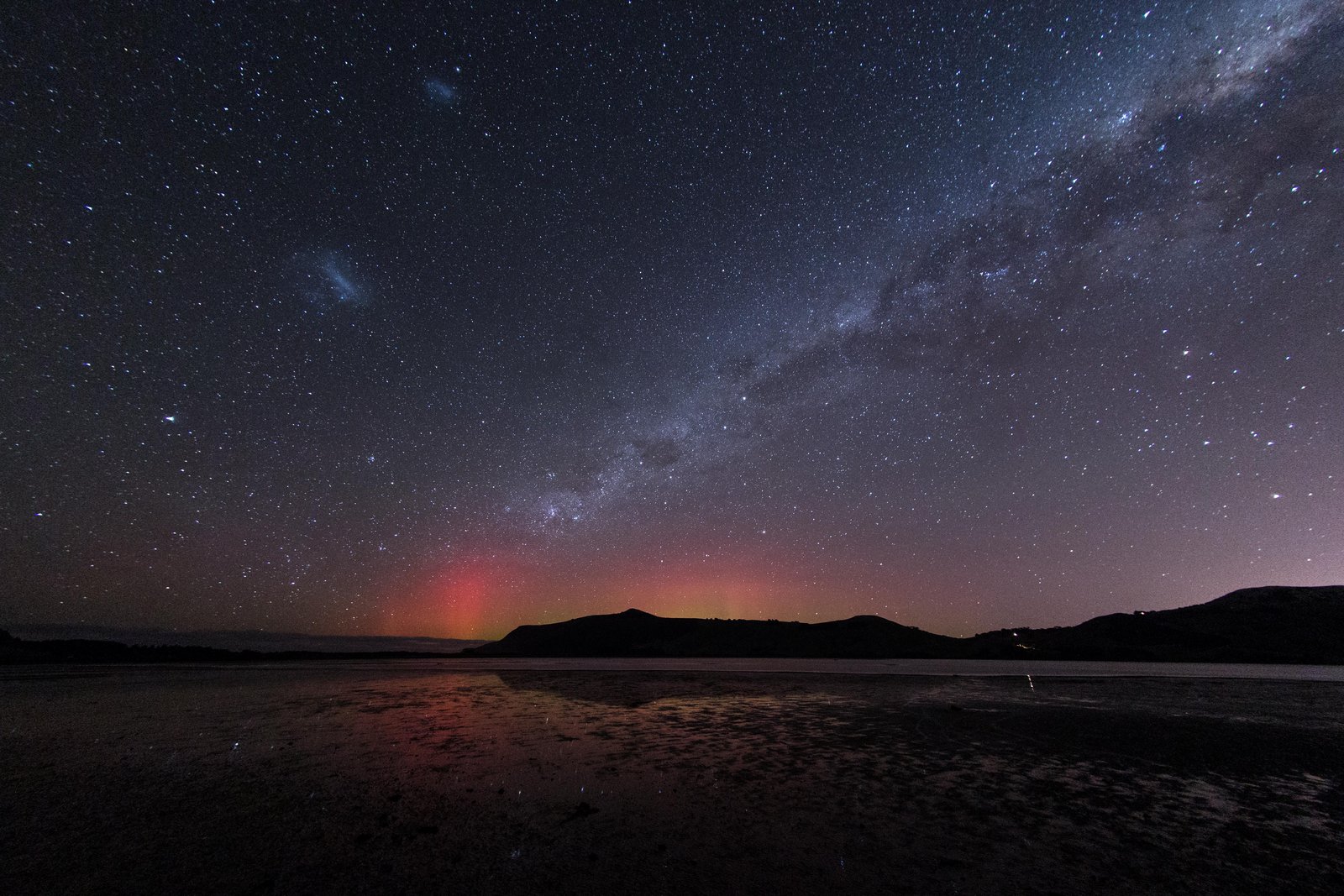
CJD: We are seeing electrons and protons basically falling out of the sky, guided by the Earth’s magnetic field into the polar regions in the Arctic and the Antarctic. And they fall out of sky and they hit the atmosphere of the Earth. And just like my hand, which is now a little bit hot and a little bit sore, it causes the atmosphere to glow and we see the pretty lights in the sky. Now, when a coronal mass ejection comes in, and really hard, those lights get brighter… But they also move from the very high latitude polar regions down towards the mid latitudes.
And so, for us to be able to see aurora in most of the UK or most of New Zealand, we want a decent coronal mass ejection to make the lights brighter and push them down towards us. If you live in Northern Scotland, here in the UK, or down in Lower Southland in New Zealand – the land of glowing skies is the Maori name for that part of the country, the Aurora is relatively common. But if you live in London, magnetically equivalent to Wellington in New Zealand, the Aurora is very uncommon. We need a decent geomagnetic storm triggered by a big coronal mass ejection to push the aurora down to those areas.
AD: You’re in Dunedin. What would that be equivalent of, latitude-wise?
CJR: Uh, Dunedin is magnetically equivalent to Edinburgh, which given that Dunedin is the Scottish city in New Zealand, it is very, very apt.
AD: That is good, that is good. But if we get hit by a coronal mass ejection, it’s not always the same that … northern lights are the same as the southern lights, right? There can be big differences, or is it pretty similar?
CJR: They’re pretty similar. Yeah, there are differences, but they’re often on the fine scale, right? You know, if you think of the pictures you’ve seen of the aurora, they’re complicated and knotty and all sorts of things are going on. It’s not like if you look in the Northern Hemisphere and the Southern Hemisphere simultaneously, you’ll see exactly the same structure because a lot of it depends on how distorted, you know, we’re basically talking about the magnetic field of the Sun being carried out by Green Lantern’s hand, by the Solar Tsunami, fighting with the magnetic field of the Earth. It’s not going to be perfectly symmetric.
But for the most part if there’s big bright lights in the Northern Hemisphere, there will be big bright lights in the Southern Hemisphere.
AD: Okay, okay, and we’re seeing the different colours, that’s different elements being excited, the oxygen…
CJR: It’s different elements and molecules in Earth’s atmosphere being excited, it’s also dependent on altitude.
AD: Right. Okay. Okay, so different colours at different…
CJR: Yes. Yes, so generally red, the bright, the strong red colour is from higher altitudes, the blues and the greens are at lower altitudes.
AD: Is that related to the energy of the impact as well? Is that relative to how strong the CME was? Or is it about the angle of the, the angle of the hit?
CJR: It’s more about the chemistry of the atmosphere, the chemistry and the physics of the atmosphere, about, so there is a certain amount of, you need some energy to excite it, but if you’re in a position that you can see those low altitudes, and low altitude is about 120 kilometres. So, it’s not exactly low altitude, it’s about reaching down and going, hello, Craig!
But you’ve got the shining light here, but for a lot of people in both the UK and in New Zealand, when they see the aurora, they see it to the poles, if you look towards the pole. So here you look north, in New Zealand you look south, and it could well be that you’re only seeing the top of the aurora, so you’d be seeing the stuff that’s at high altitude far away. And it’s when it comes close to you, and you start looking straight up at it, that you see a lot more structure and often you’ll be seeing a bit more colour if that’s the case too.
AD: Oh right, OK, fascinating. I didn’t realise it was kind of similar at the same time. I always thought it was slightly different depending on where you were.
CJR: They have different names.
AD: Yeah, Australis. How do you feel in New Zealand about it being named after Australia?
CJR: It’s Latin. I can take that one.
AD: Okay, okay, okay. CME, Solar Flare. What’s the difference?
CJR: A solar flare is an explosion on the Sun that is dominated by the fact that it’s sending out hard light, x-rays. The CME is actually a wave of material. So often that explosion on the Sun, that initial explosion on the Sun that throws out a CME, will also have a solar flare with hot x-rays.
AD: They’re travelling faster, right?
CJR: Oh, yeah. They’re travelling at the speed of light, so after the explosion eight minutes later, oh look something happened on the Sun.
AD: Right, so that’s the difference between a CME and a solar flare, and what’s the difference between the solar flare and the solar wind?
CJR: OK, so the solar wind comes down to, basically the solar wind is background activity. So, a solar flare is an explosion because that magnetic fields got all twisty and tied like we talked about. The outer atmosphere of the Sun is crazy hot, crazy hot. Like a million degrees. It’s so hot that it is boiling into space. Now we’ve talked before, people know or they’ve heard that the Sun is… Incredibly massive, heavy it’s got gravity right, but if you have something heated up to a million degrees Celsius, it can boil off into space and escape the gravitational well from the Sun. And that’s the solar wind. It’s just the outer atmosphere of the Sun just slowly boiling off into space and it just gently blows past the Earth at about 300, 400 kilometres a second. So, it’s just this gentle waft of the Sun coming out. Sometimes it’s faster, sometimes it’s slower.
AD: Should we be worried about that? Does it cause problems?
CJR: Not much. It can trigger small geomagnetic storms, which would be big enough to get nice aurora in, say, all of Scotland, maybe the north of England, say the lowest, bottom into the middle of the South Island. But for really impactful space weather events, you really need one of those coronal mass ejections to come along.
4. The real risks: Satellites, GPS, and the power grid
Timestamp: 23:37
AD: Okay, okay. Why, let’s get to the space weather. We’ve talked a little bit about the beauty of the aurora, that’s what people like seeing, but there is a very serious side to space weather that we’re kind of learning about, or have done over recent decades. You talked about it at the start as well, why it can be so impactful. Why is it important? What are the downsides of these CMEs hitting our…
CJR: So space weather is this complicated beast, and there’s a bunch of different possible risks to different technological systems. It might be that satellites that are orbiting the Earth in space might have a memory lapse, such that they forget how to talk to the Earth, or in worst case, they might just, well, drop dead. You can have the possibility of the charged part of the upper atmosphere, the ionosphere, becoming so turbulent that radio waves from satellites can’t get down to the ground or vice versa so suddenly you can’t talk to the satellites even if they’re alive. But the thing that I’ve mostly been focusing on is the risk to the power grid, to the electricity network because that’s such a fundamental part of our lives, right?
AD: We kind of rely on that, don’t we, a little bit?
CJR: Mm mm mm mm, and more and more and more with time, actually. I mean, you know, the electricity grid is this magic phenomena for most of us. I mean for most people, you don’t think about how it works, it’s just you take your plug, you plug it into the wall, and almost always electricity flows.
AD: Yeah we had a power cut the other day we didn’t know what to do it was like oh there’s no, there’s no electricity oh …
CJR: I’m sorry because, that that sounds awful!
AD: I know, it was terrible!
CJR: Thankfully, it’s relatively rare where I am. But the issue is, again, we’ve got this idea of the solar tsunami, the coronal mass ejection, Green Lantern’s hand, coming out, squeezing the magnetic field. That’s going to change the magnetic field in space. It’s going change the magnetic field on the ground. Right. It’ll be changing with time.
Now… We now unfortunately have to go back to some high school physics.
AD: Okay. I’m ready.
CJR: There is this thing called Faraday’s Law of Induction.
AD: Yeah.
CJR: Okay. Michael Faraday, famous British physicist. And he showed that a changing magnetic field will induce an electrical current on an electrical conductor. So basically, if you have a wire and you wave a magnet by the wire, you will induce an electrical current on the wire. And at school many of us had to take a wire, plug it into a meter that measured current and wave magnets around it. Now we scale it up to about the size of Wales. It would be quite good actually. So a good chunk of a country. So you’ve got an electricity grid, things that are tens to hundreds of kilometres in scale size. And we have the magnetic field of the Earth suddenly changing fast because the magnetic field’s been compressed and then that’s triggering … Currents flowing in the upper atmosphere, that’s going to be linked to our beautiful aurora and things like that, but those currents will be changing the magnetic field on the surface of the Earth as well.
So, we have currents induced in the power grid that aren’t meant to be there. And unfortunately, those currents are bad for the transformers that are the building blocks of a power grid.
So, to have a power grid, you basically need to have, you know, the transmission lines, the wires that go between cities. And obviously they’re all on pylons. Yeah, there’s the towers that hold the wires up. That’s just how we… that’s the wire that goes between cities, but when you get to the city, there is this box, which is called a transformer, which transforms the current. It’s basically going from a very high voltage that is good for moving the power between cities down to a lower voltage, which is more appropriate for us to use. Now, when those currents go into those transformers, they can make those transformers sick. And it is possible…
AD: The extra from the magnetic field change… right…
CJR: Yes those extra currents, so not the power grid currents themselves, it’s the stuff that’s induced by the changing magnetic field of the Earth. In fact we call them GIC – geomagnetically induced currents.
They’re slowly varying in time. A bunch of people will know that the AC power network in the UK and New Zealand is a 50 hertz change. These things are, they are changing quite rapidly, but on timescales of seconds, not 50 times a second. So you’ve got this slowly varying current that is coming into the transformers.
It does a thing that we call about saturating the transformer core, which can produce harmonics that flood the power network, can cause various protection systems to operate in, not in the way that we want them to operate, so they might suddenly flick off and turn off systems. Not good, but not as bad as the thing that we really worry about where it is possible, and it has happened before in the past in some countries, where you end up with hotspots in the transformer.
So, it is possibly for the transformer to end up cooking itself and thereby destroying itself. No, no, no. Very bad. Very bad, because we’re talking about units that are one, two million pounds.
AD: And that would destroy it.
CJR: Yes, destroy it, and… Hmm I have been told that the way to think about these transformers is they are like works of art.
AD: Really? OK.
CJR: Right? So, you don’t go down to the shops and buy one. You go to one of the five companies in the world who make them, and you say, I would like a transformer. And they say, oh, that’s very nice. Give us a million pounds. That’s about half the payment. And then tell us what you would like. Not just the colour, but all the finer structures and they will make it to you to order. This is what I mean by it’s like a work of art. You’re commissioning your own transformer. And then eventually, after quite a long time, they will finish it. Then you’ll give them another million pounds. And then they’ll give you your transformer. Now, at the moment, the wait time for transformers is… a year?
AD: Okay.
CJR: Two? And what we worry about in a major space weather event is that there will be many transformers burnt out all over the world and therefore the wait times could be much, much, much longer.
AD: Wow, okay, so if this coronal mass ejection hits the Earth, changes the magnetic field, that induces an increased push on the grid effectively, blows up transformers, worst case scenario, but it can have a lesser effect than that.
CJR: Oh, absolutely. And what I really want to emphasise here is that that is an extreme space weather event. That is, at least for the modelling we’ve done for New Zealand, and I’m not in a great position to be able to say exactly what the situation is in the UK, but for New Zealand, we believe that the risk starts getting very real at the sort of events that will happen about once every 75 years to once every 100 years.
So, coming from a country where we think about earthquakes and volcano risks that maybe more like once in a thousand years or more, this is actually a little bit disturbingly common.
AD: Yeah. Okay. Okay, so power, that’s obviously a big thing.
CJR: Power’s a big deal.
AD: You talked about satellites as well. People rely on their mobile phones all the time. So that that kind of thing could… If you get hit by a bad one…
CJR: Yeah, so. The GPS network or the GNSS spacecraft, the spacecraft themselves are very well designed. They are… A lot of them came from an era of the Cold War when it was possible that we’d be using nuclear weapons to settle arguments. They are very, very armour-plated. But there is a very significant issue that if that charged part of the upper atmosphere becomes so turbulent and thick that we can’t talk to the satellites for a few days… is the suggestion from the UK’s Royal Academy of Engineering. They did a report on extreme space weather in 2013.
AD: It wouldn’t be permanent.
CJR: No, no, no. Only a few days, but a few days without Google Maps. I mean, how are you going to find anywhere?
AD: What would my daughter do without a phone for an hour?
CJR: But then another really important thing is that, like, the way that those GPS systems work, they are basically flying atomic clocks, and they send out a one second pulse. And a lot of IT technology uses this as a really cheap way to make sure you’ve got a high quality synchronised clock and then you can do your networking really, really fast. And if you don’t have your own personal expensive atomic clock, which you probably don’t because you can buy a relatively cheap GPS receiver and go talk to all these flying atomic clocks. If they go away… Then that could be problematic, and again, that Royal Academy of Engineering report suggests that network systems, one example would be the cell phone network, might struggle to operate for a while, while that precision timing signal is not available. So, these are these things that we need to prepare for, I mean this is one of the things in New Zealand we’re saying that in the case of a one in 100 year storm, if things go well… People might lose power for five or six days. That’s if it goes well and we don’t have really bad equipment damage. The power network will come back after about five days.
So, you should be ready. You should have plans for how you would survive. Can you cook in your house without “electrickery”? OK. And this is one of the areas where we’re actually effectively lucky in New Zealand because we have earthquakes and volcanoes and tsunamis. The advice in general is that we should be ready to survive without power for a time period like five or six days anyway, because an earthquake might stuff the grid, or a volcano might stuff the grid, or wind might stuff the grid, or something else might stuff the grid. So, we should be ready to, so I have supplies at home, I’ve got a gas cooker, I’ve got a barbecue.
AD: And yeah… that’s commonplace in New Zealand for people to be prepared for…
CJR: Well, we’re meant to. How common it is… Well, lots of people have barbecues. Barbecues, gas barbecues, nice place for barbecues. While it’s coming into winter here in the UK, at the moment it’s moving into summer in New Zealand. When I go home it’s going to be barbecue season. Absolutely.
5. The Gannon Storm of May 2024 and protecting the grid: New Zealand’s mitigation plan
Timestamp: 34:05
AD: Okay, that’s good. So, can you give us some examples of recent events, recent space weather events?
CJR: Yes, well, one of the most exciting and recent history was May 2024, so quite recent. The Sun, the Sun effectively had a really bad day and let off about… It’s a little bit hard to tell, but on the order of about nine coronal mass ejections in short order. Not all of them were Earth directed, but six or seven of them were. So, in a relatively short time period, we got hit multiple times. We had a really big geomagnetic storm.
There was aurora viewed all over the UK.
AD: I saw it! First time ever!
CJR: Well done! I was able to walk out the front door of my house, which is in the middle of the city of Dunedin and see the aurora with streetlights and things because it was bright enough. People in Auckland were seeing the aurora. Auckland is magnetically equivalent to Budapest in your local environment.
My understanding is that people in Namibia and New Caledonia were seeing the aurora, so much closer to the equator. This was a big stonking event. And it was big enough that we ended up in New Zealand that the power industry, the electricity industry in New Zealand, triggered their mitigation plan just to put the network into a safer state. Um, just in case.
AD: Okay, so how do they do that? They can tone the transformers down in a way to adjust to that?
CJR: It’s not so much toning the transformer… So, I’ve got to admit, I’m very proud of this, so I will tell you about it in much detail, because this is a thing that was developed in my research team. One of my students went away and built this plan while working with Transpower New Zealand. You would call them the National Grid. So Transpower New Zealand is the New Zealand National Grid operator. And we went and visited Transpower and we worked with them in their control room simulator to build this mitigation plan.
So, the idea is that in many cases you have a generator here, you have customers over there, and there are wires joining them up, that’s the transmission grid. But to provide redundancy and resilience, there are lots of extra wires that aren’t needed. And they’re normally in service all the time, just in case something goes wrong.
AD: Right.
CJR: Like, you know, so that you don’t end up with power blackouts. It’s all good. But the issue is, if there are, for example, two wires joining two locations, there will be currents on both wires. And then the transformer will get… More current.
And so, what we did was we worked with Transpower on identifying locations where we could remove one of those redundant wires. So, it slightly decreases the resilience and the safety, but it decreases the currents in those hotspot locations.
AD: Right. That’s clever.
CJR: So, we only picked the transformers that um… we were expecting the currents to be a bit too high and make people a little bit too sweaty… and so once the storm got to a certain threshold, all of this had to be agreed in advance.
When you’re doing disaster response, you do not want to be making it up on the fly.
AD: No, no, no.
CJR: You want to be getting out your book and saying, we have reached this threshold. Now we do this list of things. And that’s exactly what they did. We got to that threshold. That information came out from MOSWOC and from the United States, arrived in New Zealand and they said, right, we’ve met this threshold, we’re declaring a grid emergency notice. We are reconfiguring the power grid to decrease the currents to protect the New Zealand power grid.
AD: And nothing bad happened?
CJR: Oh, nothing bad happened at all.
AD: So, it worked!
CJR: Well, it was also a relatively, that wasn’t a one-in-one-hundred-year event, that was probably a one-in-10-year event. So, it hit our threshold for a response. But… It was a good test, this was not at the level that we would have cooked anything.
6. The historic Carrington Event and how we measure storms
Timestamp: 37:55
AD: Is there a reason for that? Because the Aurora was spectacular, but this CME or this series of CMEs didn’t cause much damage to satellites or to our infrastructure.
CJR: So, it was big, but it wasn’t jaw-droppingly big. If you go back in history, we can see events…
AD: Carrington event?
CJR: Carrington event is the classic one from 1858. That was something like a 16-hour travel time from the Sun to the Earth, all because Richard Carrington happened to be sketching sunspots. And then he saw, he SAW the solar flare. He actually thought that some child had poked a hole in the screen he was using to shield the Sun so he could draw his cartoon of the sunspots.
So, he saw the solar flare, he knew when it occurred. And so, when the coronal mass ejection hit the Earth and aurora exploded over London, he was able to go, oh, that was 16 hours.
Okay, so we know quite a lot about that. My other favourite one is 1921. There was another event that we think was of a similar size to the Carrington event. In Carrington, aurora was viewed from Cuba. In 1921, people who had seen the aurora before at high latitudes were in Samoa and reported seeing aurora. So, in the Pacific, very close to the equator. That was a real big show.
AD: Good job we didn’t have satellites back then.
CJR: Absolutely. You’ve only got to wait, what, 30 something years?
AD: Yeah, so what are the, we class these storms as G1 to 5, what are, what’s the different categories with, and how does that work, is it similar to hurricanes?
CJR: Speaking as somebody from the southern hemisphere, I’m not very good with hurricanes.
AD: Cyclones?
CJR: Cyclones, absolutely, and we don’t use a 1 to 5 scale with them. But basically, G1 is, it’s a little storm and you might see some aurora if you’re very pole-wards.
AD: Right.
CJR: For space weather risks, at least for the power grid, the slight problem we have is that G5 is at the level that we really want to start paying attention. And that’s the top of the scale.
AD: Yeah, okay.
CJR: So, a small G5, is like, oh, we should really be paying attention. A medium G5’s like, oh, really, we really need to be careful. And then a big G5 is, oh dear, we may have lost 10% of the power grid. For years.
AD: So, there’s a scale that goes from one to five, but you’re saying it’s not, it’s no, you need a different scale, surely.
CJR: Mmmm, and this is one of these things that is a discussion that’s been occurring for the last few years. The scale was invented by the Americans, great people, but this particular scale is not the best. And so various people from around the world are providing feedback.
AD: Oh, right. So, we may see a new scale.
CJR: We may see a new scale, or we may just have to change the way we operate. It may be that we leave that scale behind… it’s still going to be G1 to G5, but we need a way when we are talking to our customers particularly people like the power grids… Or other people that are in space weather of giving them a feeling is this a little G5 a medium G5?
Or a… I’m not sure if I should say this but in New Zealand we’ve been referring to it as Code Brown. The G5 that is Code Brown, that’s our really worrying level. And at the moment they’re all just called G5, and that’s not a lot of use.
Just at lunch today I was saying, just imagine the idea that the earthquake scale was like this. We got up to the point where you said, oh, it’s a five, a five is like… Ooh … All the way down to, I’m sorry, the roof just fell and killed you, and you destroyed a city. This is not actually the best scale in the world, but having said that, you know, this is in retrospect. The scale was invented a while ago, at the time it all seemed sensible. Science is a learning process. Science is learning process, and we have to correct as we develop.
AD: Okay, so G5, keep up-to-date, because the storm system may change. Fascinating.
So, with these G5s, small, medium, large, as you’ve been talking about, what kind of time scales would a large be on? Would that be a one-in-a-hundred-year event? Or …
CJR: Ah, the… So, G5s appear to be 1-in-10 or something like that to meet the G5 threshold. It might be a little bit less than that in reality. The levels that we’re caring about, at least in New Zealand, is more like somewhere between 1-in-50 and 1-in-100 years, maybe it’s 1-in-75, where we would actually start seeing significant stress on the power network. The nice thing is that we’ve done some, you know, there’s been a bunch of science nerdy modelling that’s been shared with industry. Industry have gone away, gone away got their engineers, stared at it, started thinking. And for some, for example, of the generators, they’ve been able to say these are okay for us.
Some of the other generators in New Zealand have said if that happened, that’s not okay for us. And then Transpower whose job is to try and keep the lights on as best they can, they can now try and make a plan as to what New Zealand would do if we had one of those really, really big events. And we know that it is going to be significantly impactful that we would, for example, declare – and when I say we, I mean the Minister – would declare a national state of emergency to enable us to get through a storm that was a few days long – you know, two or three days of storming probably, and then a few days to rebuild the power grid.
AD: Right. In terms of the actual energy coming off the Sun, is it, which has a bigger impact? Is it if it’s a more powerful CME that has a glancing blow, or if it’s a weaker one but has a more of a direct hit?
CJR: Oh, my understanding is that it’s complicated, but we are really looking at fast, dense and head on is the…
AD: Is the worst-case scenario.
CJR: Is the worst-case scenario. I mean, you can almost imagine like a car crash, right? I mean how bad could it be? Well, how about it’s a Mack truck going at 200 kilometres an hour into my face. That’s bad.
AD: Yeah, I can see, yeah, make a YouTube video out of the different scenarios that… I like that. That’s good.
CJR: Talk to the forecasters, you can tune everything and get it right.
7. Forecasting space weather: The L1 point and warning times
Timestamp: 44:30
AD: That’s what the forecaster’s here are looking at, right?
CJR: Absolutely.
AD: The people are looking at the Sun constantly 24-7 for these events.
CJR: They can, you know, they see it coming off the Sun, they make measurements to estimate how fast it’s going, they have fancy, complicated models to help them work out, is it going to hit the Earth, is there going to be a glancing blow, is going to head on. Then the questions really come down to how dense is it, and what is the orientation of the magnetic field in the cloud.
AD: How do you measure how dense it is?
CJR: Yeah, the best way to measure it is for it to pass by a spacecraft, and this is actually part of our problem is that… I mean these spacecraft exist. There are spacecraft out there. There is a point, we call it the L1 point or Lagrange one point, where the gravitational attraction of the Sun and the Earth balance. So, there’s a location where you can put something. It’s, it’s only about a million kilometres away from Earth, okay, so it’s not super close, but the problem is that it’s… because the Sun is so heavy relative to the Earth, it’s 99% of the travel time away from the Sun. So, for the really fast events, we might get 15 minutes of warning by the time it gets to L1, before it gets to us. Normally, it’s more like an hour, maybe even a bit more.
But 15 minutes, that’s gonna be a stressful day, right? So, it would be really good if we could come up with ways of getting measurements that are closer to the Sun, or some very clever scientist comes up with other ways of remote sensing that coronal mass ejection as it’s coming. And I know some people are thinking hard and have got some good ideas. It’s not gonna happen tomorrow, but, science doesn’t, you know, it’s… Hopefully we will evolve.
AD: Is that when it gets classified then, is the G one to five? How soon after a bang?
CJR: People will be forecasting the possibility. So, for example, if they see something coming off the Sun very, very fast, or maybe a couple of them coming off the Sun very, fast, they’ll say, there’s certainly a possibility of a G5, which would at least cause people to, you know, open their eyes and start paying attention.
Then it would get to L1, get to this point in space where they can make measurements. You wouldn’t necessarily classify it at that point, but you might say, it really feels like this is probably going to be a G5. Generally, the call is to, it’s a G-5, is once it’s happening, so it’s actually hit the Earth, the magnetic field is going crazy, there’s beautiful auroras somewhere and you go, oh yeah, G5, yeah.
In fact, in the Gannon, the event in May 2024, which is named after Jennifer Gannon which is why I call it the Gannon Storm.
AD: Who was Jennifer Gannon?
CJR: Jennifer Gannon was a space weather researcher in the United States, who died just shortly before that storm, and so it was named in honour of her. And she had done an awful lot of work in space weather, both with scientists but also with community and government. And she worked a lot with power grids and so, it was a really fitting memorial to her.
And it was the biggest event that we’d seen in 15 or 20 years and so you know, there’s respect shown.
AD: Oh, nice, nice. That’s beautiful. What could happen? What’s a reasonable worst case?
CJR: Okay, so reasonable work case scenario.
AD: Maybe talk about New Zealand.
CJR: So, we are using the UK 1-in-100-year reasonable worst-case scenario and then we’ve applied it in the New Zealand context. And this is reasonable because, as we talked about earlier, Edinburgh… Is Dunedin, London is Wellington. So, if I take a document that is true for the UK, it applies to New Zealand rather well.
Okay, so we take the one-in-100 reasonable worst case from the UK. We apply it to New Zealand. We have gone away and calculated a number of different scenarios as to how the currents in the power grid would work. This took us years, because first of all, we had, of course, to develop a validated simulation model to be able to go and make those, to do that final hazard estimate… Although we were very fortunate that Transpower in New Zealand has been measuring those currents over a couple of decades, so we could build a validated model, and then we crank up the intensity to the one-in-one-hundred-year level. And we did a bunch of different scenarios, and we discovered that basically the transformers that are going to get too hot, as it were, that there’s too much current, do not change very much from scenario to scenario. And that’s mostly because while the magnetic field storms will be a bit different from event to event to event to event, an awful lot depends on what our ground is like and how the power grid is plugged together. And that doesn’t change from event to event to event. Just the magnetic field changes a bit. And so, we found that more or less the same transformers in the same cities were our problem sites and… The downside is it’s about 10% of the power grid, the total power grid fleet. And that is an unacceptably high number.
AD: Okay.
CJR: So, the… One possibility, of course, is you could sit there and say, okay, we’ll just see if we survive. And so, you just sit there and see okay, so 10% of the transformers might go on fire. Let’s just count how many will go on the fire. Now, nobody wants to do that. Turns out that each one of these transformers is like a million pounds. It will be years before we can get a replacement. This is a dumb plan. So, and we’ve invested, you know, taxpayers, people have invested a lot of money, customers in all of this hardware. The idea of just saying, let’s just see, let’s just see. So basically, a plan is being put together in New Zealand by the electricity industry, led by Transpower, but working with all the main generating companies as to what they would do in that sort of event. And it involves switching off some of the transformers that would be the most at risk.
And the idea would be that you would leave them off for the two or three days that the storm was on and then you power them back on and we have a fully functioning electricity network with no damage. We had a couple of days where, okay, yep, some people will potentially not have electricity.
AD: Tactical switch-offs.
CJR: Tactical switch-offs, yeah, and it’s geographically dependent because it depends on the nature of the local ground and the way the power network is configured. The impacts will be larger in the South Island, and also actually around Auckland. City of Auckland.
AD: So, you can model where.
CJR: Absolutely. I mean, this is 10 years worth of getting ready for this, but yes, we have quite high fidelity in terms, we can say, you know, it’s that transformer, in that substation, in that city. I mean you can go to Google Earth and go look at pictures of these things, and you really can go away and say “there it is”.
8. Preparing for the worst: From “the bunker” to international collaboration
Timestamp: 51:42
AD: Ah, fascinating. I expect there’s a whole science, itself, of modelling these kind of things and working.
CJR: Yeah! Yes. But this is one of the things that’s been, we’ve been really lucky in New Zealand is that there’s the nerdy research scientists who are trying to do this, but we’re working so strongly with industry. I mean, industry, they had to give us so much information so that our modelling had high quality. And then they looked at the results of our modelling and they trusted our modelling and went, ah, we have to do something now. And after the Ganon storm in May 2024, where they did that thing, that also caused a lot of interest across the New Zealand government, New Zealand politicians to say, ooh. What happened there? And in December of last year, the National Emergency Management Authority of New Zealand produced our first national space weather response plan. So, like we have this written document as to what our country would do.
And three weeks ago we had an exercise with 140 people in “the bunker” that is under the Beehive… the Beehive is the executive wing in New Zealand, the Prime Minister has offices on the top. Under the building is the bunker where civil defence would just…
AD: You ran through an exercise
CJR: Yep, we had a pretend exercise as…
AD: A big g5
CJR: A code brown, absolutely, yes. And so I was pretending to provide the science advice and not do the whole sort of “aaaah”…
AD: Yeah, I bet. Finally, I mean, you’re here obviously in the UK, so international collaboration around this is really important. Are people learning from what you’re doing, do you know of other countries that are planning in similar ways that you guys are?
CJR: There are certainly people who are learning from us, we’ve been, we’re really, really fortunate in that we are working strongly with industry, but they are not blocking us providing this information internationally. We are writing it into the scientific literature where other people can read it, we’re going to conferences, we talk to people. I need to emphasise that when we started doing this about ten years ago… We got the measurements from Transpower New Zealand, but we started off with some modelling code that we worked with the British Geological Survey, who developed this modelling code over the years, and they were kind enough to let us work with that code. We had to change it and things, so it worked in the New Zealand context, maybe even some upgrades, but fundamentally it’s because of these links, these partnerships. These are old friends of mine that I’ve known for years and years and years.
I think I met Alan and Ellen for the first time in Birmingham in 1999 at a conference. And then in 2015, it’s like I’ve won some money and can we work on this research area together? And now we’re at the point that I want to come here to the UK to try and tell people about some of the interesting things that we’ve learned because you guys have helped us get there.
But I think you can also learn from us. Because my power industry have got these measurements that they’re willing to share, and they’re willing to work with us a whole lot. But then we can get to the point that the conclusions, well, it’s up to your power grid operators in your country to decide whether it applies for you. I can’t work that out myself, actually, but it’s quite possible that it will. And it’s only fair that we talk and share.
AD: Brilliant. Oh, that’s fantastic. Let’s end on that positive, let’s end on that positive.
CJR: Great, thank you.
AD: Professor Craig, Roger, thank you so much. It’s been absolutely fascinating. I’ve learned an awful lot. Brilliant. Thank you very much for joining me.
I hope you’ve enjoyed this deeper dive. Do let us know in the comments if you have and what you think about the whole concept in general. If you’ve got any questions. Put them in the comments as well. Comments about this, questions about this about space weather. We’ve got our own space weather department. So even if we can’t get hold of Craig to answer the questions, we can ask our space weather experts to answer.
So if you’ve got questions about space weather, put them, but if you’ve got any other ideas about other experts that we could interview, other topics that you’d like us to go into, put those in the comment as well, but once more, thank you very much, Craig and thank you for watching.
CJR: Mā te wā!