Solar Tsunamis: Next Generation Space Weather Prediction and Response for New Zealand (STNG)
2025 – 2030
In 2025, the Solar Tsunamis project was awarded Endeavour funding from MBIE to continue our research for a further five years. The new project, referred to as STNG, comprises the following work packages:
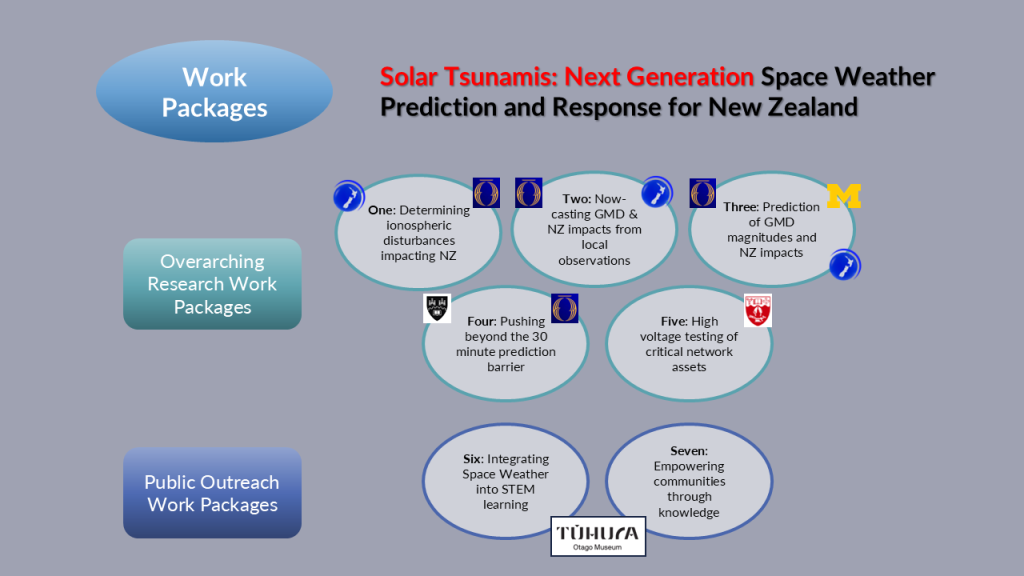
STEM = Science, Technology, Engineering and Mathematics
The Big Picture goals of this new project are:
- Develop NZ-specific space weather predictions and indices that are useful for the hazards identified for us – particularly for electricity sector partners such as Transpower, and government partners such as NEMA and MBIE.
- Expand on the existing geomagnetic disturbance focus and include NZ ionospheric disturbances, including their impacts on Global Navigation Satellite System (GNSS) Position, Navigation and Timing (PNT) impacts.
- Try to push beyond the existing ~30 minute limitations for extreme event warning times using machine learning.
- Develop now-casting tools for NZ space weather impacts covering the electricity industry, GNSS, and solar flares.
- Test the capability of electricity network switching equipment and continue to support the NZ Electricity Industry Space Weather Working Group (EISWWG) to mitigate the impacts of space weather.
- Grow NZ resilience to space weather impacts through proven methods of community-focused science engagement and STEM pathways by continuing to work with Tūhura Otago Museum on public outreach.
Why prediction matters
Space weather is currently rated on an international scale from G1 (minor) to G5 (extreme), but this scale wasn’t designed with New Zealand’s specific needs in mind. STNG aims to:
- Develop forecasting tools that are more useful for New Zealand’s emergency planning and response than the standard G1–G5 scale
- Give New Zealand’s electricity industry longer advance warning before a space weather event hits
- Test whether protective equipment in the power grid will actually work during the most extreme space weather conditions
More than just the power grid
While protecting New Zealand’s electricity grid is one important focus, STNG also looks at how space weather affects GNSS (satellite navigation, like GPS) and the ionosphere — the upper layer of our atmosphere that satellite signals travel through.
In the United States, a 2024 solar storm caused a two-day outage of satellite-based aircraft landing systems at around 2,000 airports — the first disruption of its kind since 2007. Another storm later that year caused further problems. Farmers using high-precision GPS for planting also experienced disruptions during the same period.
New Zealand relies on accurate satellite positioning for everything from IT systems to aerospace, so understanding these risks is just as important here.
STNG’s collaboration with the National Emergency Management Agency (NEMA) and the Ministry of Business, Innovation and Employment (MBIE) ensures the project aligns with real New Zealand needs and national emergency planning.
STNG Partners and Collaborators













Solar Tsunamis: Space-Weather Prediction and Risk Mitigation for New Zealand’s Energy Infrastructure (ST1)
2020 – 2025
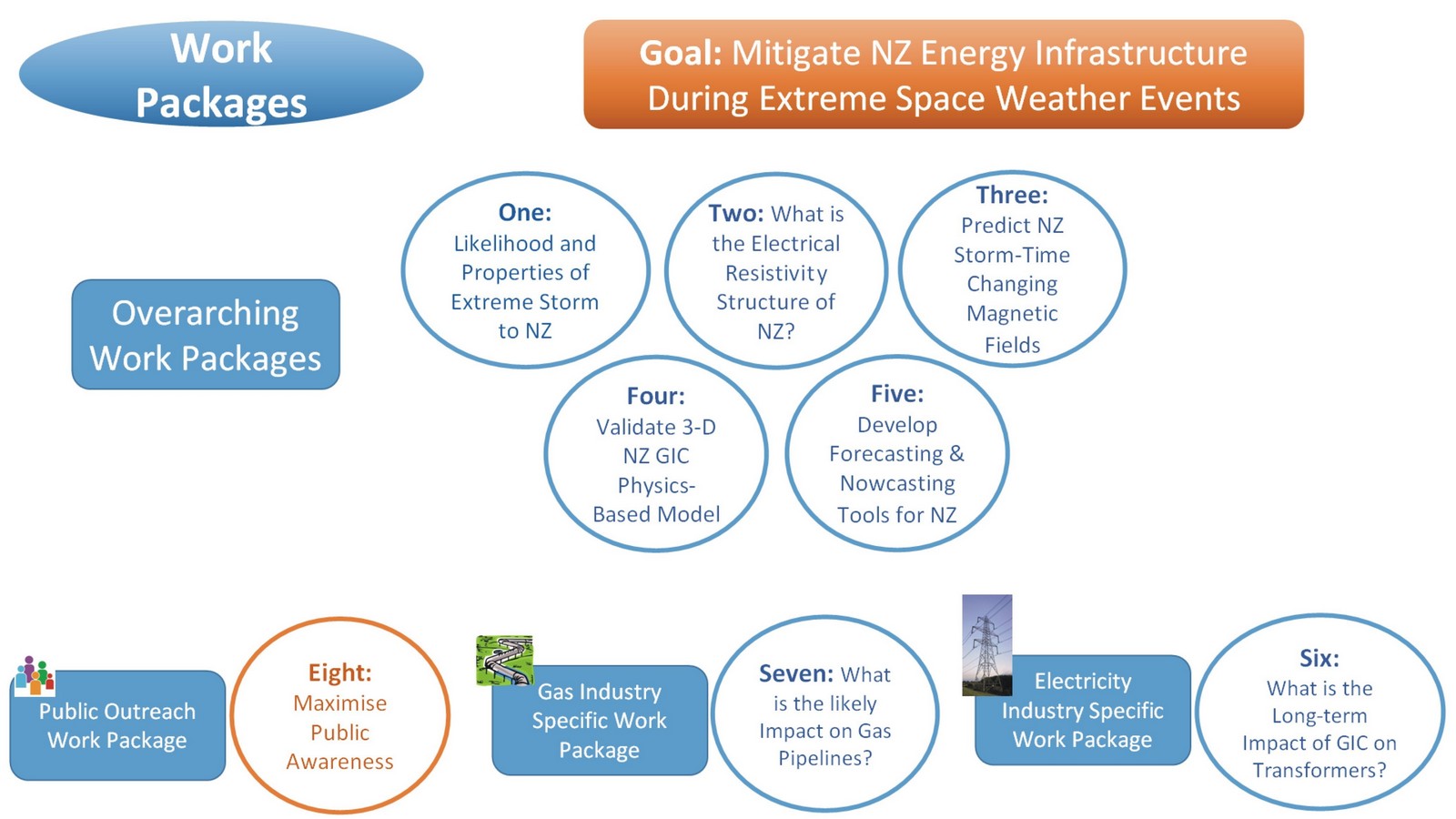
The Solar Tsunami Endeavour Programme is an international collaboration led by the University of Otago to understand how New Zealand’s energy infrastructure will be impacted by an extreme space weather event. We do not know when extreme space weather will occur, it could be in the next few centuries, or it could be tomorrow. This research project will help prepare Aotearoa New Zealand for that event. The project will investigate how solar explosions – massive ejections from the Sun called Coronal Mass Ejections (CME) – impact our ground based energy infrastructure. As our reliance on advanced technology becomes more pronounced, this field has become increasingly important globally. In the New Zealand context we primarily focus on our electrical transmission and gas pipeline networks.
Unusually large space weather events have previously occurred globally and in New Zealand, causing blackouts and destruction of multi-million-dollar equipment. For the USA alone, the estimated cost of such an event is US$0.5-2.7 trillion. A very rough estimate for New Zealand suggests an annualised risk cost of NZ$1 billion a year. Solar explosions drive rapid changes to the Earth’s magnetic field. Through Faraday’s law, changing magnetic fields induce currents in wires and pipelines. It is these induced currents, if large enough, that can destroy transformers and cause pipelines to rapidly corrode. This happens, to some degree, annually, with large “geomagnetic storms” occurring most years. The key risk however is around extreme events at the 1 in 100 year to 1 in 200 year level.
The fundamental questions we need to answer are:
– How likely, and how big, will such extreme storms be?
– Can they be forecasted?
– What impact would that have on our critical energy supply networks?
Our energy industry partners have identified the key questions that need to be answered to protect New Zealander’s from the worst of the impacts of such solar tsunamis. Our research will address these questions to allow mitigation of the extreme storm space weather hazard. Through our highly collaborative international partnerships we will also benefit from and contribute to the leading-edge research being undertaken into space weather and solar storms globally.
The Solar Tsunami project is funded by the Ministry for Business, Innovation & Employment’s Endeavour Programme fund. The Solar Tsunami Endeavour Programme involves the following institutions, research partners, and industry partners:
University of Otago, University of Canterbury, Victoria University of Wellington, GNS Science, British Geological Survey, British Antarctic Survey, University of Texas at Arlington, Tūhura Otago Museum, Ministry for Business, Innovation and Employment, Transpower, Firstgas, ETH Zurich, NOAA Space Weather Prediciton Centre, Space Weather Canada.